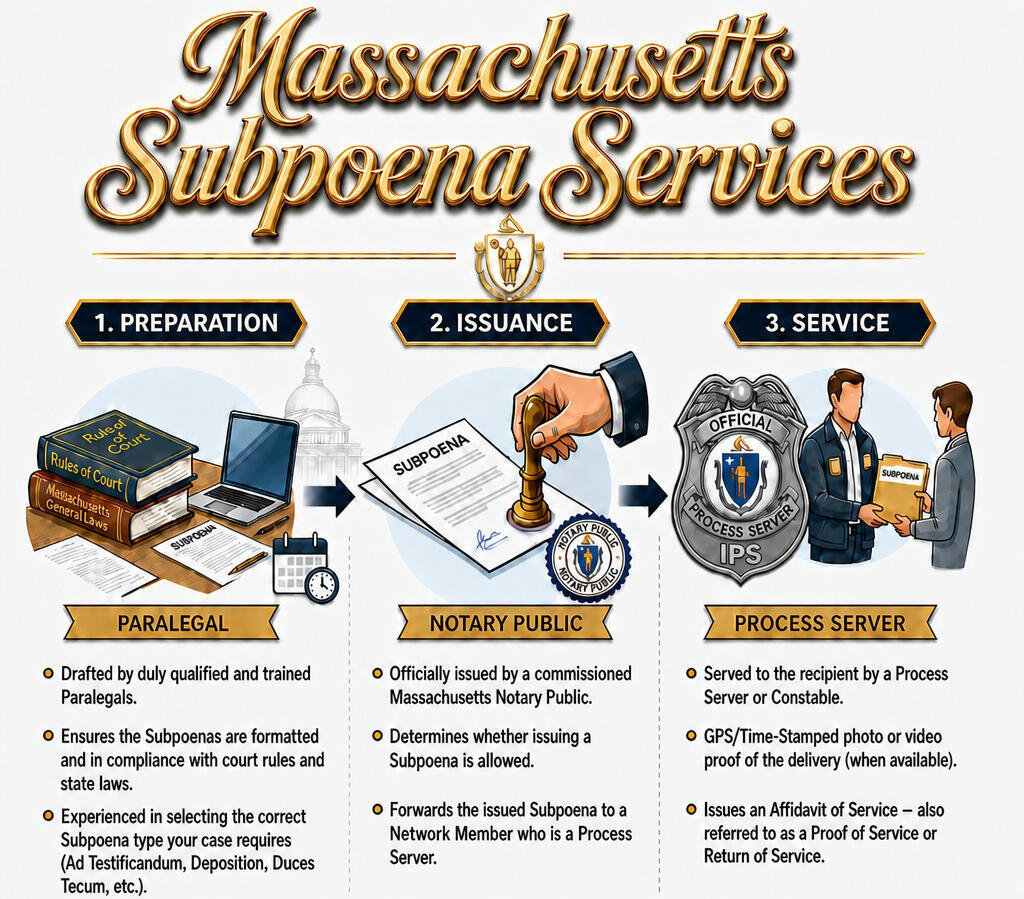
Massachusetts Subpoena Workflow
Our streamlined workflow ensures every subpoena is handled with accuracy, compliance, and professionalism. A qualified Notary Public — who is also a trained Paralegal — prepares the subpoena in full compliance with Massachusetts court rules.Once complete, the subpoena is officially issued by the Paralegal in his or her capacity as a Notary Public and forwarded to a Network Member who is legally authorized to serve court process. The Process Server then delivers the subpoena directly to the recipient, following all legal requirements and providing GPS‑verified proof of service when available. From preparation to delivery, each step is managed by certified professionals to ensure compliance and peace of mind.
Legal Authority to Draft, Issue, and Serve Subpoenas
Authority to Draft and Prepare Subpoenas:
Our notaries public are trained and experienced professional paralegals and are qualified to draft subpoenas in accordance with Massachusetts General Laws, Chapter 222, Section 17(d). This statute requires that a notary public be duly qualified, trained, or experienced in a particular industry or professional field before selecting, drafting, or completing a certificate or other document related to a matter within that industry or field. Because our notaries are paralegals, we meet — and exceed — this statutory requirement.
Authority to Issue Subpoenas:
Massachusetts Rules of Civil Procedure, Rule 45(a): "Every subpoena shall be issued by the clerk of court, by a notary public, or by a justice of the peace, shall state the name of the court and the title of the action, and shall command each person to whom it is directed to do the following at a specified time and place: to attend and give testimony; to produce designated documents, electronically stored information, or tangible things in that person's possession, custody, or control; or to permit inspection of premises..."Massachusetts General Laws, Chapter 233, Section 1: "A clerk of a court of record, a notary public or a justice of the peace may issue summonses for witnesses in all cases pending before courts, magistrates, auditors, referees, arbitrators or other persons authorized to examine witnesses, and at all hearings upon applications for complaints wherein a person may be charged with the commission of a crime; but a notary public or a justice of the peace shall not issue summonses for witnesses in criminal cases except upon request of the attorney general, district attorney or other person who acts in the case in behalf of the commonwealth or of the defendant. If the summons is issued at the request of the defendant that fact shall be stated therein. The summons shall be in the form heretofore adopted and commonly used, but may be altered from time to time like other writs."Massachusetts General Laws, Chapter 30A, Section 12(3): "Any party to an adjudicatory proceeding shall be entitled as of right to the issue of subpoenas in the name of the agency conducting the proceeding. The party may have such subpoenas issued by a notary public or justice of the peace, or he may make written application to the agency, which shall forthwith issue the subpoenas requested. However issued, the subpoena shall show on its face the name and address of the party at whose request the subpoena was issued. Unless otherwise provided by any law, the agency need not pay fees for attendance and travel to witnesses summoned by a party.
Authority to Serve Subpoenas:
Network Members are licensed Constables and authorized Process Servers, which means they are legally permitted to serve Subpoenas as well as a wide range of other court documents. This includes divorce papers, complaints, contempt summonses, probate and family court filings, and additional legal notices that require formal service. Their authority ensures that every document is delivered properly, in accordance with Massachusetts law, giving clients confidence that their paperwork has been served correctly and on time.
Massachusetts Subpoena Intake Form
Massachusetts Constable Services
Professional Process Server
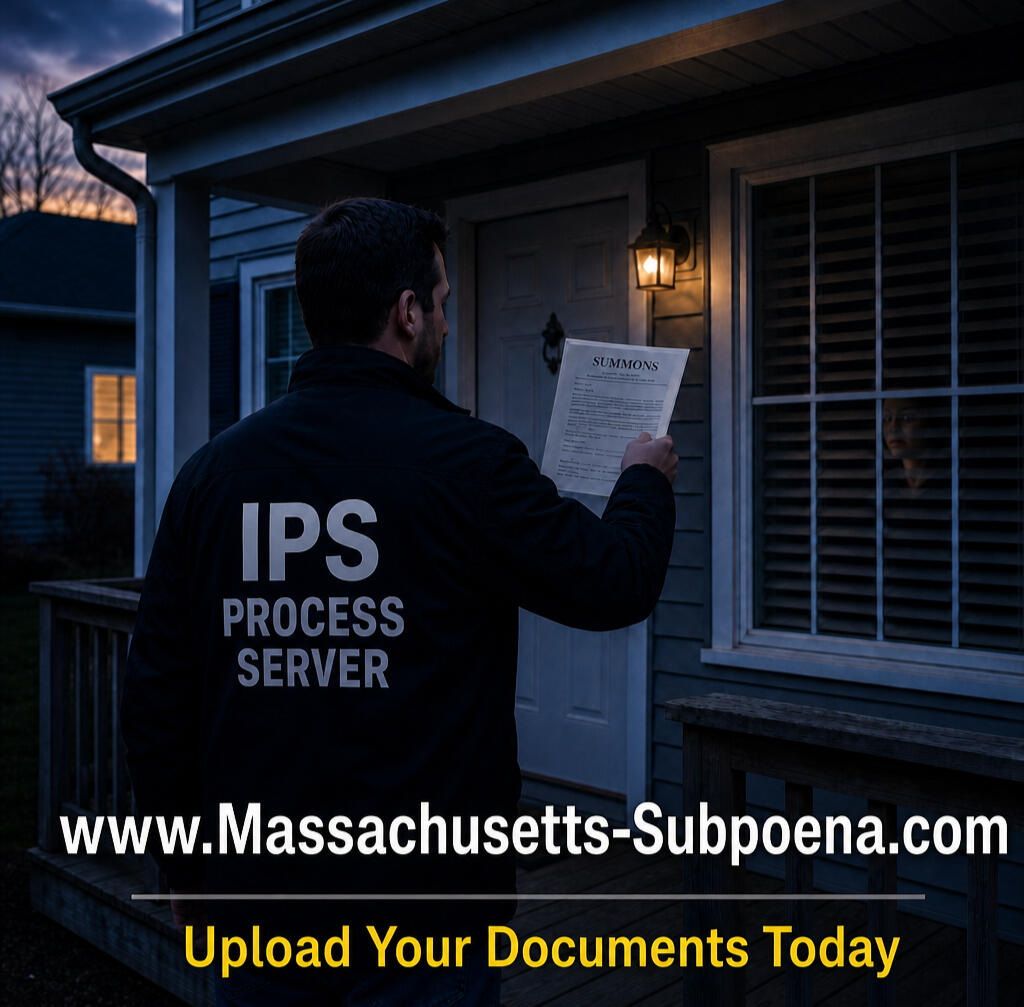
A process server is a professional authorized to deliver legal documents—such as summonses, subpoenas, complaints, and court orders—to individuals or entities involved in a legal proceeding. Their role is essential to the justice system because it ensures that every party is properly notified of legal action against them, giving them the opportunity to respond. This act of notification is not just procedural—it’s a cornerstone of constitutional due process, which guarantees that no one is deprived of life, liberty, or property without fair notice and an opportunity to be heard.
By serving documents accurately and verifying delivery through affidavits or proofs of service, process servers uphold the integrity of the judicial process. They act as neutral messengers of the court, ensuring that cases can proceed lawfully and that defendants cannot claim ignorance of proceedings. In essence, the process server is the living link between the court and the citizen—protecting the constitutional right to due process by making sure justice begins with proper notice.Ready to have your legal papers served? You may either fill out the form below, or fill out the Massachusetts Process Server Request Form, and upload your documents for service.
Court Papers We Serve
Subpoenas (State & Federal) – For witnesses, records, or evidence you need for your case.Federal Summons & Complaint – When starting a case in federal court.Domestic Relations Summons – Used in Probate & Family Court matters (divorce, custody, support).Complaint for Modification – When asking the court to change an existing order.Probate Citations – Official notices required in probate matters.14‑Day Notice to Quit – For nonpayment of rent in landlord‑tenant cases.30‑Day Notice to Quit – For terminating a tenancy at will.Notice of Trespass – To formally warn someone to stay off your property.Motions, Letters, and Other Court Filings – Any written request or communication you must submit to the court.Contempt Summons – When asking the court to enforce an order someone is violating.
Process Service Intake Form
© IPS-Notary 2026